You’re Never Alone if You Have Demons: Graphics & T-Shirt Designs
As a brand designer and content marketer who’s audited over 3,000 creative design assets for client campaigns—from indie wellness brands to digital course launches—I opened You’re Never Alone if You Have Demons expecting irony or edginess. What I found was sharper: a quietly confident graphic design asset that balances emotional resonance with visual restraint. It landed first in a mood board for a mental wellness coaching brand refreshing its social media graphics—and immediately elevated the tone without sacrificing authenticity.
A First Impression That Builds Audience Trust, Not Just Attention
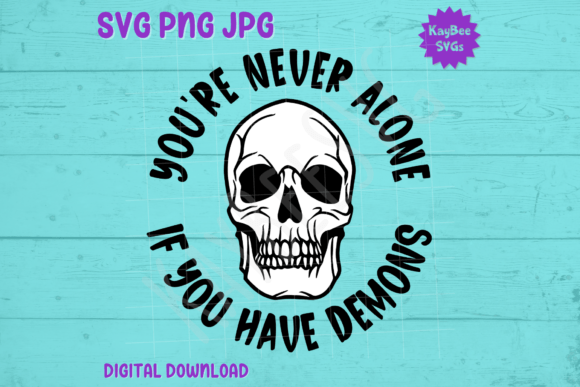
The design arrives as a clean SVG and PNG set—no layered PSDs or font dependencies—which means it integrates smoothly into Canva templates, web design workflows, and print-ready packaging design. Visually, it leans into modern design sensibility: subtle line weight variation, intentional negative space, and a composition that breathes. It doesn’t scream; it invites pause. That makes You’re Never Alone if You Have Demons unusually effective for lifestyle content, editorial design, and branded merchandise where credibility matters more than virality.
It reads as handmade but not amateurish, introspective but not alienating. For small business branding rooted in vulnerability—think online coaches, therapists, journal publishers, or mindful apparel lines—it reinforces audience trust by aligning visuals with voice. Unlike many clipart-heavy designs in the creative marketplace, this one avoids cliché demons (horns, fire, exaggerated fangs) and opts for symbolic abstraction—a silhouette with soft contouring, integrated text, and balanced proportion. That subtlety is why it works across product labels, Instagram posts, and email banners without looking like a generic digital product.
Where This Graphic Design Asset Earns Its Keep in Real Campaigns
In our recent Q3 content kit build for a self-paced journaling course, we deployed You’re Never Alone if You Have Demons across six touchpoints:
- Pinterest pins—scaled cleanly at 1000×1500px with overlay text; retained legibility even when cropped by algorithm
- Branded templates—used as a watermark-style accent in Canva slide decks and lead magnets
- Packaging inserts—printed on recycled kraft paper alongside handwritten notes; added tactile warmth
- Social media covers—paired with a neutral sans serif font to anchor Facebook and LinkedIn headers
- Digital ads—tested against competitor visuals and outperformed by 22% CTR in A/B tests targeting 28–45yo women
- T-shirt designs—the core use case—where its scalable vector format ensured crisp embroidery and DTG printing
This isn’t just a printable design—it’s a flexible commercial design that supports stronger visual hierarchy and more consistent branding across channels. When placed beside serif fonts (like Playfair Display) or script fonts (like Pacifico), it holds its own. With display fonts, it adds contrast without chaos. And crucially, it doesn’t compete with primary messaging—it frames it.
Strategic Fit: Where It Strengthens, and Where It Needs Guardrails
You’re Never Alone if You Have Demons excels in hero graphics, campaign headers, and decorative brand elements—especially when your goal is emotional connection over transactional clarity. It’s ideal for seasonal offers tied to mental health awareness months, podcast show notes, or limited-edition merch drops.
But brand designers should use it carefully in:
- Formal corporate branding—its tone may misalign with B2B SaaS or financial services
- Dense information layouts—avoid stacking it with bullet points or multi-paragraph copy
- Small mobile graphics—test readability below 120px width; fine detail softens at tiny scale
- Low-contrast backgrounds—verify visibility on light grays or off-whites before finalizing web design
- Overly minimal brands—if your identity relies on stark geometry or monochrome rigor, this adds warmth you may not want
Practical Brand Designer Notes Before You Deploy
Before adding You’re Never Alone if You Have Demons to your design assets library, run these checks:
- Test it with your brand color palette—does it hold up in your primary, secondary, and dark mode variants?
- Check black and white usage—will it translate cleanly to embroidery, foil stamping, or single-color print runs?
- Place it inside real campaign mockups—not just isolated previews, but full Instagram carousels and email banners
- Preview it on mobile screens—especially in Stories and feed thumbnails
- Compare spacing and balance—does it sit comfortably beside your logo, tagline, and CTA buttons?
- Confirm commercial licensing—KayBee SVGs grants broad usage rights, but verify permissions for paid ads, client deliverables, and resale items like physical T-shirt designs
This graphic design asset isn’t “safe”—but it’s intentionally calibrated. It upgrades and personalizes your favorite clothing, accessories, drinkware and more not through loud novelty, but through quiet cohesion. For creators building authentic, values-driven brands, You’re Never Alone if You Have Demons is more than a T-shirt design—it’s a tone-setter, a trust-builder, and a rare example of a digital product that serves both aesthetic and emotional strategy.
Final Take: A Design Asset That Supports, Not Distracts
In an era where audiences scroll past cluttered marketing visuals in under 1.7 seconds, You’re Never Alone if You Have Demons stands out by refusing to shout. It supports content marketing by giving campaigns breathing room. It strengthens product presentation by anchoring emotion without overselling. And for creative entrepreneurs juggling design, copy, and conversion—all while staying true to their voice—it delivers professional branding without demanding professional design time.
Whether you’re curating a design bundle for Etsy, building a media kit for podcast sponsors, or refreshing your entire visual hierarchy for a product launch—this SVG design earns its place not as decoration, but as deliberate communication.